

Most of us know we should have an estate plan. But the hard part is often figuring out what that actually means.
Do you need a will? A trust? Both? Does owning a home change the answer? What if you have children, a blended family, or older documents that no longer fit your life?
These are normal questions, and the answer is not one-size-fits-all.
A will and a trust are different tools. One is not automatically better than the other. The better question is:
Which option fits your family, property, and goals?
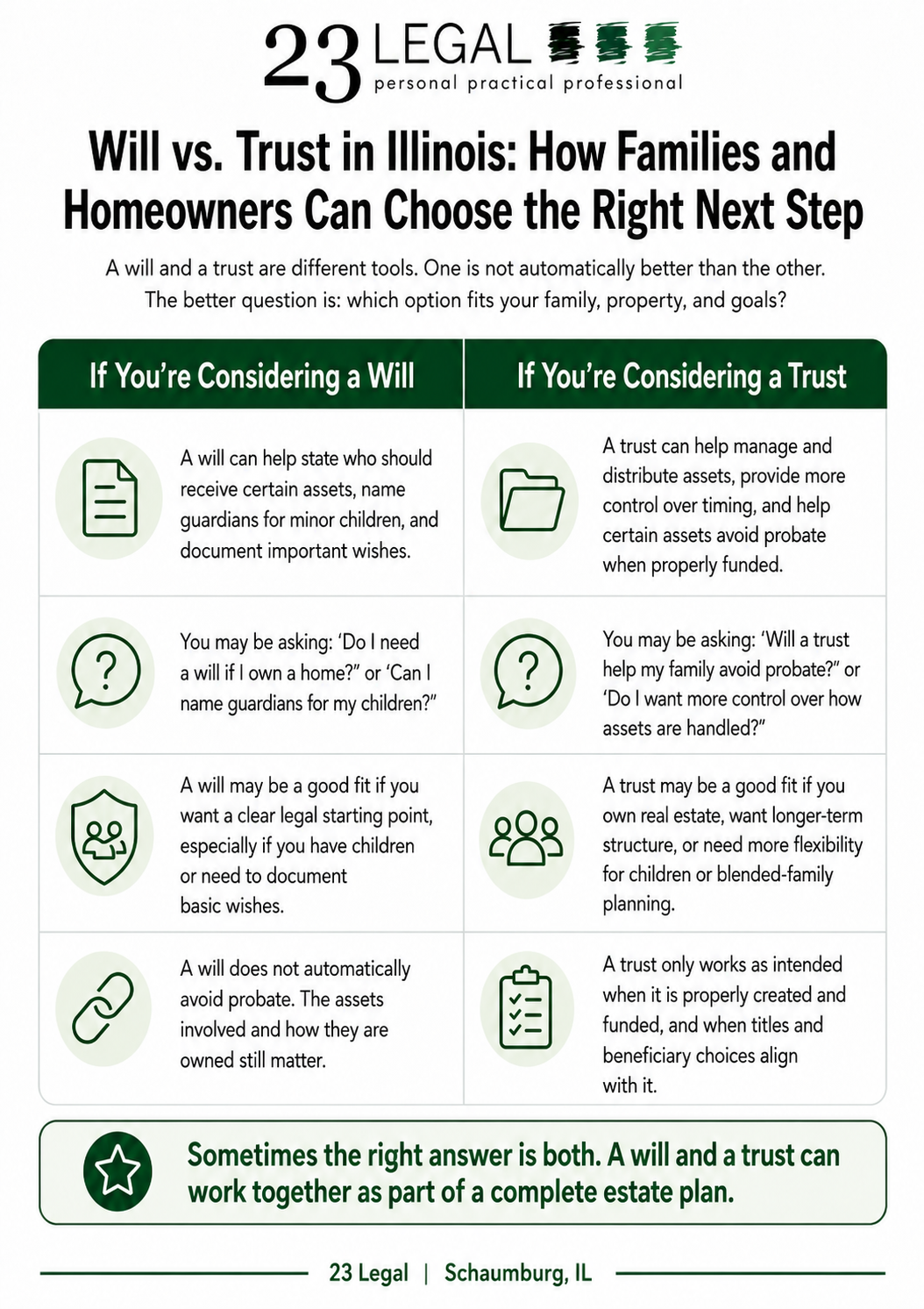
Start With the Difference Between a Will and a Trust
A will is a legal document that can explain how certain assets should be handled after death, name beneficiaries, and address guardianship wishes for minor children.
A trust is a legal arrangement that can hold and manage assets according to instructions set by the person creating it. Depending on how it is structured and funded, a trust may provide more control over when or how assets are distributed and may help certain assets avoid probate.
Sometimes a will is enough. Sometimes a trust makes sense. In other situations, both documents may be part of the same estate plan.
The right answer depends on what you own, who you want to protect, and what you want the plan to accomplish.
What a Will Can Help You Do
A will can help make your wishes clearer after death.
Depending on your situation, it may help you:
- Name who should receive certain assets
- Name guardians for minor children
- Document important estate planning wishes
- Create a clear starting point for your overall plan
A will can be especially important for parents because it can address guardianship wishes for children.
It is also important to understand that simply having a will does not automatically mean probate will be avoided. Probate is the court process that may be used to administer an estate and transfer certain property after death. Whether probate is required depends on the assets involved, how they are owned, and other details of the estate.
What a Trust Can Help You Do Differently
A trust can provide more structure around how certain assets are managed and distributed.
For example, a trust may be useful if you want to:
- Control how and when beneficiaries receive assets
- Create longer-term instructions for children or loved ones
- Provide continuity in the management of certain assets
- Help certain assets avoid probate when they are properly placed in the trust
That last point is especially important.
A trust does not work simply because the document exists. The assets that are supposed to be controlled by the trust generally need to be properly transferred into it.
That is one reason estate planning should be coordinated carefully. A trust, property title, and other ownership documents should work together instead of pulling in different directions.
Does Owning a Home Mean You Need a Trust?
Not necessarily.
Owning a home does make estate planning more important because real estate is often one of a family’s largest assets. But that does not mean every homeowner automatically needs a trust.
The better questions are:
- How is the home titled?
- Who should receive it later?
- Do you own it alone or with someone else?
- Are there minor children or blended-family considerations?
- Would you want more control over how or when the property is handled?
- Are you trying to reduce probate concerns?
For some homeowners, a trust may make sense. For others, a will and other estate planning documents may be enough.
The goal is not to choose the most complicated option. It is to choose the option that fits the family, property, and goals involved.
What About Children or Blended Families?
Children and blended-family relationships can add more questions to an estate plan, especially when property and long-term asset decisions are involved.
Parents with minor children may need to consider guardianship wishes, who should manage assets for children, and when children should receive those assets.
Blended families may need extra clarity around spouses, children from prior relationships, property ownership, and beneficiary decisions.
A will may address some of these concerns. A trust may provide more structure around others.
The important thing is not to assume that a generic form will account for the relationships and responsibilities in your actual family.
Estate planning works best when the documents reflect real life.
What Role Does Probate Play?
Probate is one of the main reasons people begin comparing wills and trusts.
A will does not avoid probate simply because it exists. Instead, a will may be used during the probate process to explain how certain property should be handled.
A trust may help certain assets avoid probate when those assets are properly held in the trust. But probate avoidance is only one part of the decision.
Other questions may matter just as much:
- Do you have minor children?
- Do you own real estate?
- Do you want more structure around asset distribution?
- Is privacy important to you?
- Do you have a blended family?
- Are there concerns about managing assets over time?
The goal should not be to avoid probate at all costs. The goal should be to create a plan that actually fits the people and property involved.
Questions to Ask Before Choosing a Will, Trust, or Both
If you are trying to decide what kind of estate plan makes sense, start with a few practical questions:
- Do you own real estate?
- Do you have minor children?
- Is your family blended?
- Do you want more control over how and when assets are distributed?
- Are you concerned about probate?
- Do you already have older estate planning documents?
- Does your current property ownership match your wishes?
- Have you recently bought a home, gotten married, had children, or experienced another major life change?
You do not need to know every answer before talking with an attorney.
These questions simply help identify what the plan may need to address.
“We have used Ben and his team for both real estate and estate planning. They are responsive and good to work with. Ben makes the estate planning process easy to understand. Highly recommend their law practice.” — Pam Mish
You Do Not Need to Choose Alone
One of the biggest reasons people put off estate planning is that they think they have to decide what they need before they start.
You do not.
You do not need to walk into a conversation already knowing whether you need a will, a trust, or both.
You can start with what you own, who you care about, and what you want to make clearer.
From there, the right estate planning tools can be chosen based on your actual family, property, and goals.
Not Sure Whether You Need a Will, Trust, or Both?
You do not need to figure that out on your own.
23 Legal can help you understand how your family, property, and goals fit together and what estate planning tools may make sense for your situation.
Reach out, and we’ll start your will-vs-trust conversation today.
23 Legal is a Schaumburg-based law firm with more than 15 years of experience in real estate law and estate planning. The firm helps more than 300 clients each year navigate important legal decisions with clarity, confidence, and practical guidance.